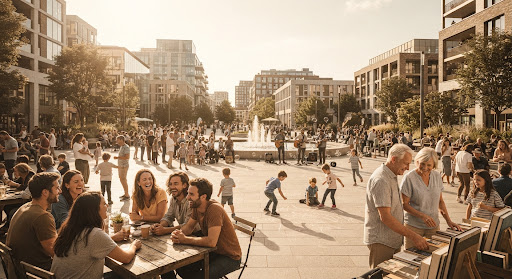
The public square has been declared dead roughly once a decade since the invention of the automobile. It keeps failing to die. In cities from Salvador to South London, modest, unglamorous squares are doing quiet structural work—holding neighbourhoods together in ways that the surrounding housing policy actively undermines.
What a Square Actually Does
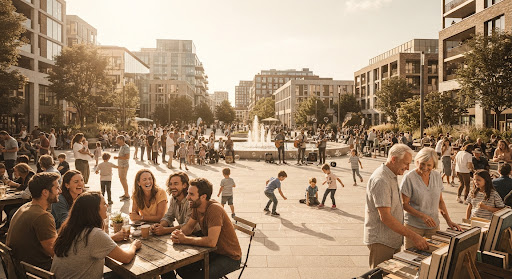
Ask residents what the square is for and the answers are mundane: shade, a place to wait, somewhere to let children run within sight. Ask them what happens without it and the answers turn structural—isolation, the disappearance of the casual encounters that make it possible to ask a neighbour for help.
Sociologists have a term for this: weak ties. They are the relationships that carry information about jobs, housing and services, and they are formed almost entirely in shared public space.
You cannot programme your way to a neighbourhood. You can only make it easy for people to stay.
— Marcus T., on Praça da Sé
Designing for Loitering
The most successful squares share unfashionable features: generous seating without commercial obligation, deep shade, a water source, and edges soft enough that adjacent shops spill outward. The least successful are optimised for circulation, which is a polite way of saying they are designed to prevent staying.
Hostile detailing—armrests mid-bench, sloped ledges, sprinklers on timers—is usually justified as maintenance. Its actual function is to determine who is permitted to rest.
Stewardship Beats Programming
Municipalities tend to reach for programming: markets, concerts, activation. These help briefly. What sustains a square over decades is stewardship—someone with standing to sweep it, unlock it, and object when it is neglected.
The squares that thrive almost always have a named custodian, formal or otherwise. The ones that fail are usually owned by everyone and defended by no one.
Revitalising these spaces requires less money and more restraint than most regeneration budgets assume. Shade, seating, water, and the political will to let people linger without buying anything—the ingredients are cheap. The willingness is the scarce resource.